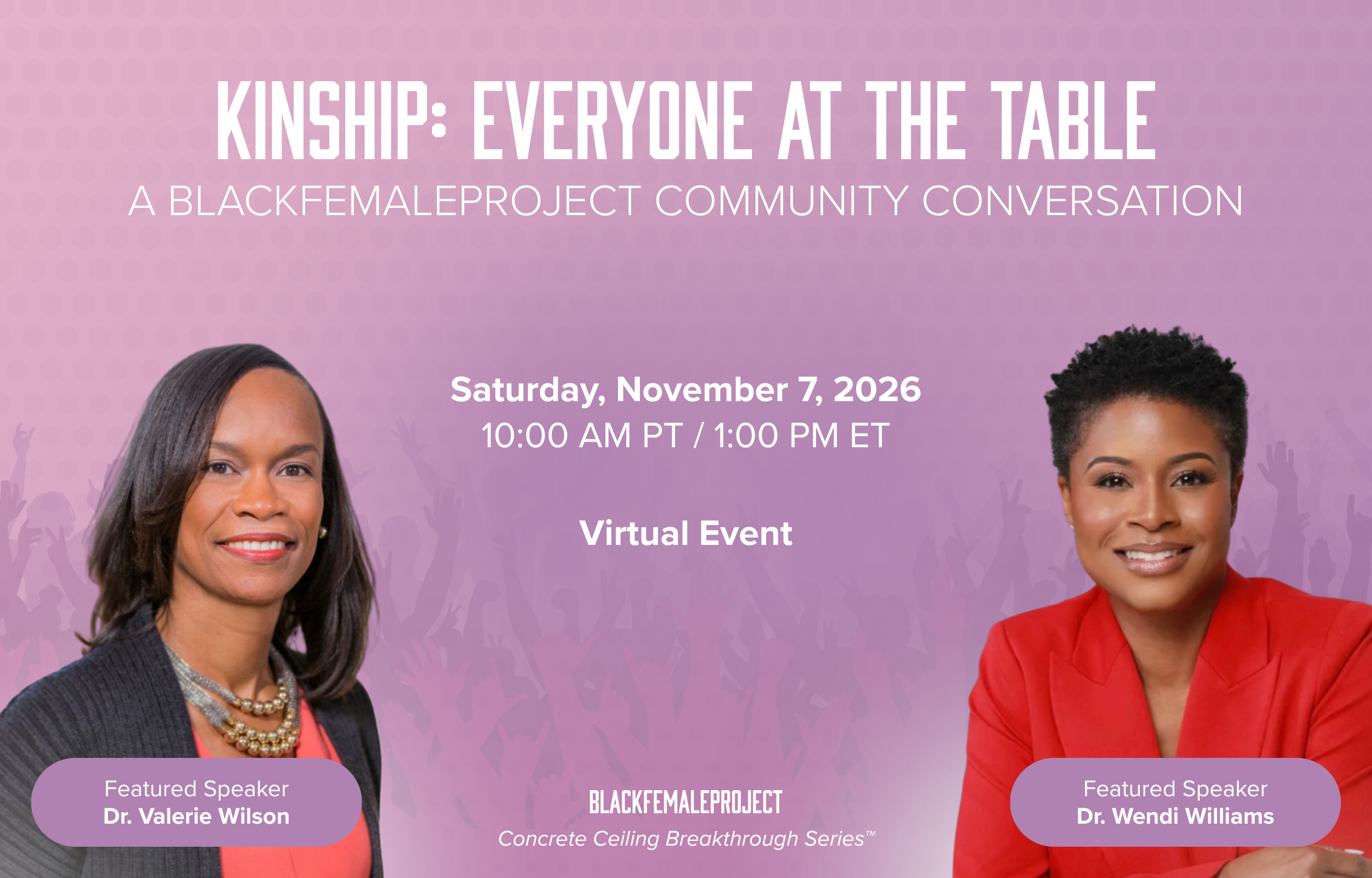
You've heard of the glass ceiling. This is different.
Join us for an enlightening, powerful, and movement building community conversation introducing The Concrete Ceiling Breakthrough.
The Concrete Ceiling names the barrier Black women face at work when racial bias and gender bias compound, a barrier that isn't glass and isn't purely racial, but something built at the intersection of both. It's harder to see through and harder to break than the frameworks built for other groups. Researchers named it in 1999. It's held up in academic study for 27 years, including Harvard Business School Press research and dozens of peer-reviewed studies. But unlike "glass ceiling," it never entered everyday professional vocabulary. Today, that changes!
For 12 years, BlackFemaleProject has documented the concrete ceiling directly from Black women professionals, building the evidence base through systematic narrative analysis and the Hewlett-funded Teacher Truth Initiative's work with thousands of Black educators. We have the evidence, the methodology, and the community's trust. This is where that evidence powers a campaign.
We need diverse voices at the table to have a rich discussion.
Who should attend:
Black women professionals who want language for the patterns behind their own workplace experiences
Donors and funders seeking impact beyond a financial contribution
Organizational partners, HR and workplace culture and practices professionals, and executives looking for an evidence-based framework
Community advocates and co-conspirators ready to use their platforms to amplify Black women's voices
This campaign is built on a simple belief: personal advancement and collective advancement aren't separate goals. When Black women rise, that rise is bound up with everyone around them rising too. Policymakers, funders, employers, and everyone who cares about progress aren't spectators to that future. They're co-creators of it.
Gather your people. This one's even better together. Host a watch party for Kinship: Everyone at the Table with your sister circle, your book club, or your HR professionals association, and watch it as a group. Bring snacks, bring an open mind, and stick around after for your own conversation. The breakouts are built for a room of five, so your watch party is basically doing the format already.
Meet the Speakers:
Dr. Wendi Williams is a psychologist, scholar, and leadership strategist whose work lives at the intersection of equity, institutional transformation, and sustainable leadership. Bridging psychology, education, and leadership with clarity, compassion, and transformative insight, she has spent more than two decades in higher education and the nonprofit sector accompanying leaders through the places other frameworks will not go—the moments of transition, displacement, and reckoning that demand not just strategy, but a different way of being in leadership altogether.
Her scholarship illuminates the inner lives and everyday brilliance of Black women, translating research into culturally responsive strategies that drive personal and organizational change. This work is grounded in the Black Women's Liberatory Leadership (BWLL) Praxis framework she coined—a body of thought that has become a universal blueprint for leaders committed to impact, justice, and the long arc of change. From keynote stages to intimate coaching circles, she brings that research to life through storytelling, strategic thinking, and transformative leadership development for leaders and teams committed to more effective, inclusive, and transformative leadership.
Valerie Rawlston Wilson (she/her) is a labor economist and Director of the Economic Policy Institute’s Program on Race, Ethnicity, and the Economy (PREE), a nationally recognized source for expert reports and policy analyses on the economic condition of America’s people of color. As PREE Director, Wilson has worked to elevate EPI’s thought leadership on issues of racial and economic justice and expand PREE’s capacity to prescribe policy solutions that center racial equity. Prior to joining EPI, Wilson served as Vice President of Research at the National Urban League, where she played a pivotal role in the production of the organization’s annual signature publication, The State of Black America, and assisting the historic civil rights organization in shaping its national economic policy. In 2022, she was President of the National Economics Association, an organization founded to promote the professional lives of black economists while expanding knowledge of economic issues of particular interest to communities of color. In 2023, she was elected to become a fellow of the National Academy of Public Administration.
Throughout her career, Wilson has written extensively on various issues impacting racial economic inequality in the United States—including employment, wage, income and wealth disparities—and has also appeared in major print, television, and radio media. Wilson has testified before Congress on racial disparities in unemployment and earnings and was keynote speaker for the regional Federal Reserve Banks’ series on Racism and the Economy: Focus on Employment. She has twice served on National Academies panels charged with proposing ways to improve the EEOC’s ability to measure and collect pay information from U.S. employers in support of the agency’s responsibility to investigate charges of pay discrimination. In 2010, through the State Department’s Bureau of International Information Programs, she was selected to deliver the keynote address at an event on Minority Economic Empowerment at the Nobel Peace Center in Oslo, Norway.